VH-AQJ
de Havilland D.H.82A Tiger Moth
(c/n DHA23/T262)
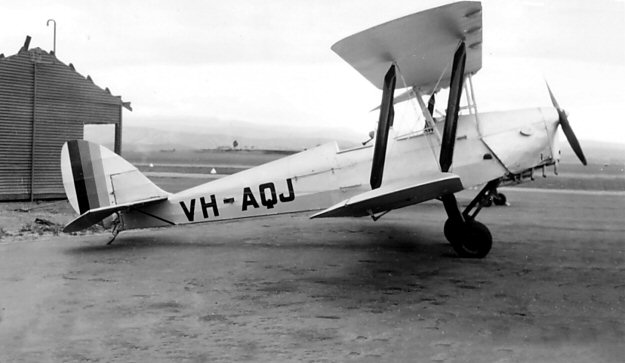
Almost indistinguishable from its Tasmanian
Aero Club stable mate VH-AQI, this aircraft was
built
slightly earlier than the previous one (in 1940, vs 1941 for
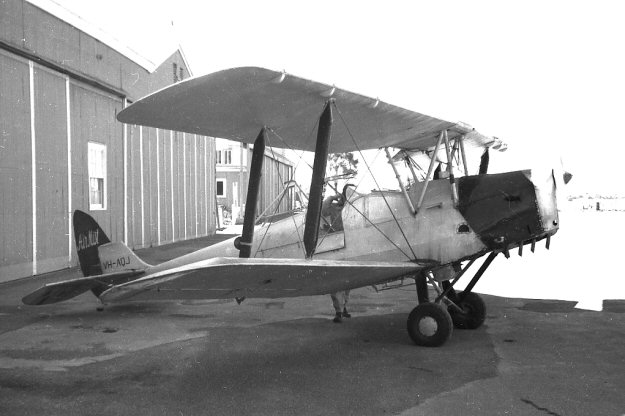
-AQI). It is seen above at
Launceston Airport
in 1952. just after I had taken it 'for a spin'. Imagine my
surprise, therefore,
on a hot
day in January
1958 when I was "trolling"
for photos at Moorabbin when I came across
my
old friend from those
Tassie Aero Club days masquerading as a crop duster! (Photo # 2
below).
In
the mid-1950s
many ex aero club Tigers were
purchased
by the aerial agriculture industry and
converted into single-seat
dusters. A decade later
DCA decided to ground all D.H.82As from agri-
cultural
work by 31
December 1965 due to the high
accident rate and serious injuries to the pilots
in comparison
to more
modern aircraft types. A 3-year
fleet reduction plan was implemented which
required each company to
reduce a third of its DH.82s
each year. In many cases this was achieved
by
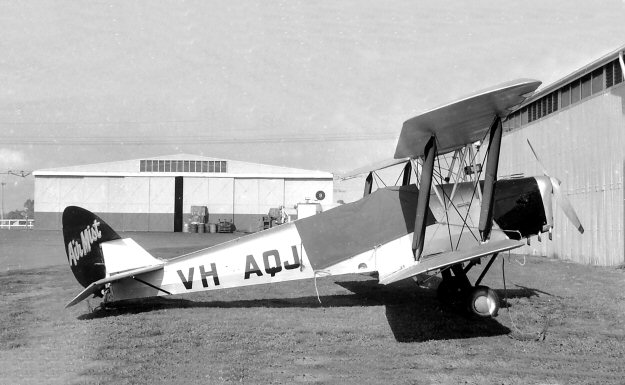
cross-leasing. Shot
# 3, taken by Bob Neate at
Bathurst, NSW in September 1963, shows -AQJ
which was
registered to Air
Mist Pty Ltd of
Parafield with its Air Mist titles removed and those of
another
company
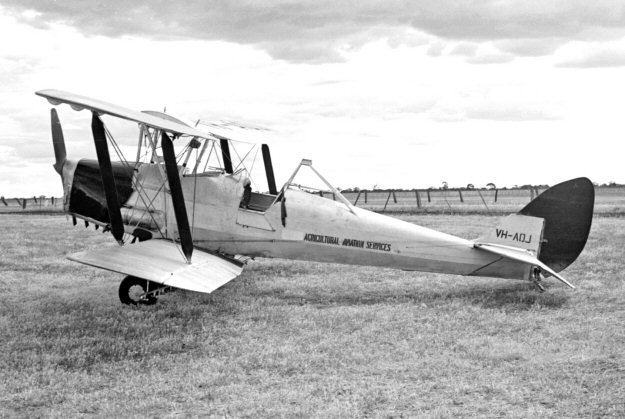
on the fuselage. The fourth shot of this much photographed Tiger
by Geoff
Goodall
illustrates it
whilst the aircraft was still deployed at
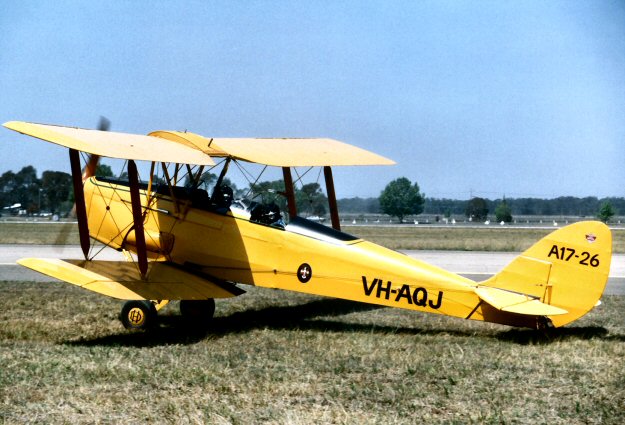
Parafield, S.A. in 1962. VH-AQJ
was formerly
with the RAAF as A17-26. It later was retired at
Parafield in October 1965 and abandoned and
dismantled in a truck compound. Most of
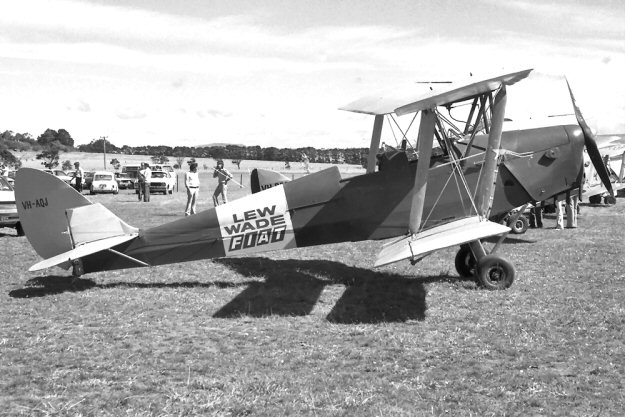
the airframe was collected and restored by Lew Wade
at
Moorabbin in 1973 using parts of VH-SSG and VH-BEU. Photo
No. 5 below, by David Tanner
shows it
following Lew's rebuild. It was
destroyed in a fatal crash near Sale, Vic on 29 December
1979. A "new"
-AQJ appeared on the register in October 1984, an early example of
Ray Windred's
remarkable
Tiger Moth factory at Luskintyre NSW. Ray
had also acquired some parts of -AQJ
salvaged
from Parafield in the 1960s, and used these as identity for his new
ground-up rebuild which
was
painted with the
original -AQJ's RAAF serial A17-26. Barry Maclean
took the photo
of it at
the
bottom of the
page (# 6) at Richmond in
1991 when it was displaying the rather odd combination
of its
RAAF
serial number on the
rudder and the somewhat crude rego on the fuselage For
complete-
ness
sake I will leave
this hybrid machine as part of this original VH-AQJ entry.
2.
3.
4.
5.
6.